

What is the accuracy of the length measurement during the welding process of a pvc window welding machine?
Hey there! As a supplier of PVC window welding machines, I often get asked about the accuracy of length measurement during the welding process. It's a crucial aspect that can significantly impact the quality of the final PVC windows. So, let's dive right into this topic and explore what goes on when it comes to measuring lengths accurately in PVC window welding.
First off, why is accurate length measurement so important? Well, PVC windows need to fit precisely into the openings where they'll be installed. Even a tiny error in length can lead to problems like improper fitting, gaps around the edges, and compromised insulation. That means less energy - efficiency and a less aesthetically pleasing result. So, getting the length right is non - negotiable.
Now, how do our PVC window welding machines achieve accurate length measurement? One of the key factors is the advanced sensors we use. These sensors are designed to detect the exact position and length of the PVC profiles. They work in real - time, constantly monitoring the profiles as they move through the welding process. For example, some of our Automatic Integrated PVC Window Welding And Corner Cleaning Line are equipped with high - precision laser sensors. These lasers can measure the length of the profiles with an incredibly high degree of accuracy, often within a few millimeters.
Another important aspect is the control system. Our machines have sophisticated control systems that can adjust the welding process based on the measured length. If the sensor detects that a profile is slightly longer or shorter than the set length, the control system can make immediate adjustments. It might slow down the feeding speed of the profile or adjust the position of the welding heads to ensure a perfect weld. This kind of real - time adjustment is what helps us maintain a high level of accuracy.
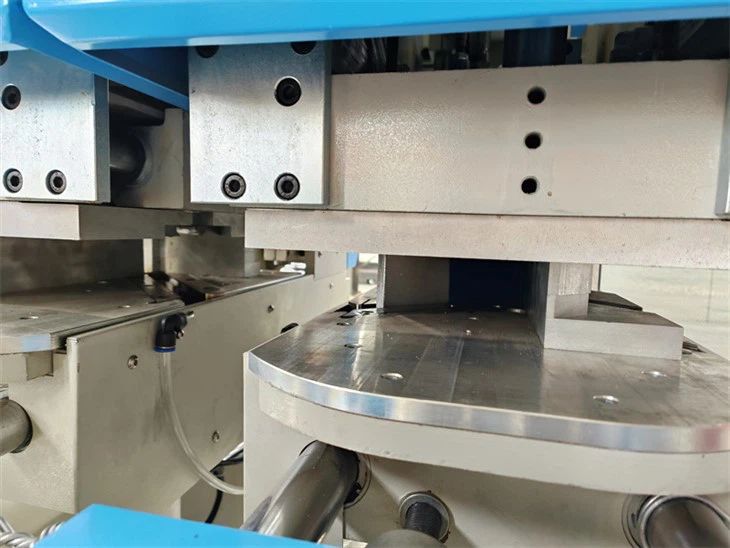
We also pay a lot of attention to the mechanical design of our machines. The guides and fixtures that hold the PVC profiles in place are engineered to be very precise. They ensure that the profiles are aligned correctly and that there is no movement or shifting during the welding process. This stability is essential for accurate length measurement. For instance, in our UPVC Seamless Welding Machine, the mechanical components are made from high - quality materials and are machined to very tight tolerances. This helps to minimize any errors that could occur due to mechanical play or misalignment.

However, it's not just about the machine itself. The operator also plays a crucial role in ensuring accurate length measurement. We provide comprehensive training to our customers so that they know how to set up the machine correctly and how to operate it to achieve the best results. Operators need to make sure that the profiles are loaded properly and that the machine settings are adjusted according to the specific requirements of each job. They also need to perform regular maintenance on the machine to keep the sensors and other components in good working condition.
In addition to the technical aspects, we also conduct a lot of quality control checks during the manufacturing process. We test our machines thoroughly to make sure that they can consistently measure lengths accurately. We use sample profiles and measure them multiple times to verify the accuracy of the measurement system. If there are any issues, we make the necessary adjustments before the machines are shipped to our customers.
But what about the external factors that can affect length measurement? Temperature and humidity can have an impact on the PVC profiles. PVC is a plastic material, and it can expand or contract depending on the environmental conditions. Our machines are designed to take these factors into account. Some of our models have built - in sensors that can detect changes in temperature and humidity and adjust the measurement system accordingly. This helps to ensure that the length measurement remains accurate regardless of the external conditions.
Now, let's talk about the different types of welding processes and how they relate to length measurement. There are mainly two types of welding processes used in PVC window manufacturing: hot - plate welding and friction welding. In hot - plate welding, the PVC profiles are heated by a hot plate and then pressed together to form a weld. In friction welding, the profiles are rubbed against each other at high speed to generate heat and form a weld.
In both cases, accurate length measurement is crucial. For hot - plate welding, the length of the profiles needs to be measured precisely so that the hot plate can be positioned correctly. If the length is off, the hot plate might not heat the profiles evenly, which can lead to a weak weld. In friction welding, the length measurement affects the amount of friction generated between the profiles. If the length is incorrect, the weld might not be strong enough.
Our PVC Window Welding and Corner Cleaning Line is designed to work with both types of welding processes. It can accurately measure the length of the profiles and ensure a high - quality weld, no matter which welding method is used.
In conclusion, the accuracy of length measurement during the welding process of a PVC window welding machine is a multi - faceted issue. It involves advanced sensors, sophisticated control systems, precise mechanical design, well - trained operators, and consideration of external factors. At our company, we've put a lot of effort into developing machines that can achieve a high level of accuracy.
If you're in the market for a PVC window welding machine and are concerned about length measurement accuracy, we'd love to hear from you. We can provide you with more detailed information about our machines and how they can meet your specific needs. Whether you're a small - scale window manufacturer or a large - scale production facility, we have the right solution for you. So, don't hesitate to reach out and start a conversation about your PVC window manufacturing requirements.
References
- Industry standards for PVC window manufacturing
- Technical manuals of our PVC window welding machines
- Research papers on plastic welding and measurement accuracy