

Can a glass cutting table be used for large - scale glass production?
In the realm of glass manufacturing, the question of whether a glass cutting table can be used for large - scale glass production is a crucial one. As a seasoned supplier of glass cutting tables, I've witnessed firsthand the evolving needs of the industry and the capabilities of our equipment. In this blog, I'll delve into the factors that determine the suitability of a glass cutting table for large - scale production, exploring its benefits, limitations, and the technological advancements that have made it a viable option for many manufacturers.
The Basics of Glass Cutting Tables
Before we assess their suitability for large - scale production, let's understand what a glass cutting table is. A glass cutting table is a specialized piece of equipment designed to cut glass sheets with precision. It typically consists of a flat surface where the glass is placed, a cutting tool, and a control system that guides the cutting process. The cutting tool can be a diamond wheel, a carbide blade, or a laser, depending on the type of glass and the desired cutting quality.

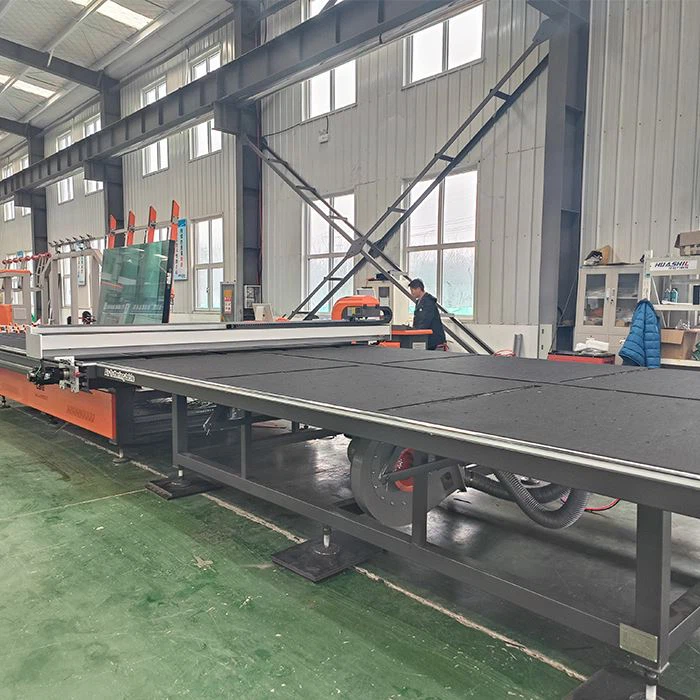
There are various types of glass cutting tables available in the market, each with its own features and capabilities. For instance, the Automatic Glass Cutting Machine offers high - speed and automated cutting, reducing the need for manual intervention. On the other hand, the Integreted Glass Cutting Machine integrates multiple functions, such as cutting, scoring, and breaking, into a single unit, enhancing efficiency. And the Large - Size CNC Glass Cutting Line is specifically designed to handle large glass sheets, making it ideal for large - scale production.
Advantages of Using Glass Cutting Tables in Large - Scale Production
One of the primary advantages of using a glass cutting table in large - scale production is precision. In large - scale manufacturing, even a small error in cutting can lead to significant waste and increased costs. Glass cutting tables are equipped with advanced control systems that ensure accurate cutting, reducing the margin of error to a minimum. This precision is crucial for applications where the glass needs to fit precisely into a specific frame or structure, such as in the automotive and construction industries.
Another benefit is efficiency. Modern glass cutting tables are designed to operate at high speeds, allowing for a large number of glass sheets to be cut in a short period. This is particularly important in large - scale production, where time is of the essence. Additionally, many glass cutting tables are automated, which means they can run continuously without the need for constant human supervision. This not only increases productivity but also reduces labor costs.
Glass cutting tables also offer flexibility. They can be programmed to cut different shapes and sizes of glass, making them suitable for a wide range of applications. Whether it's a simple rectangular shape for a window or a complex curved design for a decorative piece, a glass cutting table can handle it. This flexibility is essential in large - scale production, where manufacturers often need to produce a variety of glass products to meet the diverse needs of their customers.
Limitations and Challenges
While glass cutting tables offer many advantages, they also have some limitations when it comes to large - scale production. One of the main challenges is the initial investment. High - quality glass cutting tables can be quite expensive, especially those with advanced features and capabilities. This can be a significant barrier for small and medium - sized manufacturers who may not have the financial resources to purchase such equipment.
Another limitation is the maintenance requirements. Glass cutting tables are complex machines that require regular maintenance to ensure optimal performance. This includes cleaning, lubrication, and replacement of worn - out parts. Failure to perform proper maintenance can lead to breakdowns and reduced efficiency, which can be costly in large - scale production.
In addition, the size of the glass cutting table can be a limiting factor. Some large - scale production processes may require the cutting of extremely large glass sheets, which may not fit on the standard-sized cutting tables. In such cases, manufacturers may need to invest in larger and more specialized equipment, which further increases the cost.
Technological Advancements
Over the years, there have been significant technological advancements in the field of glass cutting tables, which have addressed many of the limitations and challenges mentioned above. For example, the development of more affordable and high - performance control systems has reduced the cost of glass cutting tables without compromising on precision. These control systems also allow for easier programming and operation, making it more accessible for manufacturers with limited technical expertise.
In terms of maintenance, new materials and designs have been introduced to improve the durability of glass cutting tables. For instance, some cutting tools are now made of advanced materials that are more resistant to wear and tear, reducing the frequency of replacement. Additionally, remote monitoring and diagnostic systems have been developed, allowing manufacturers to detect and address potential problems before they cause significant downtime.
The size issue has also been addressed with the development of larger and more versatile glass cutting tables. The Large - Size CNC Glass Cutting Line mentioned earlier is a prime example of such advancements. These cutting lines are capable of handling large glass sheets, enabling manufacturers to meet the demands of large - scale production.
Conclusion
In conclusion, a glass cutting table can indeed be used for large - scale glass production. It offers precision, efficiency, and flexibility, which are essential in large - scale manufacturing. While there are some limitations and challenges, such as the initial investment and maintenance requirements, technological advancements have made glass cutting tables more accessible and reliable.
If you're in the glass manufacturing industry and are considering large - scale production, a glass cutting table could be a valuable addition to your production line. Whether you need an Automatic Glass Cutting Machine for high - speed cutting, an Integreted Glass Cutting Machine for integrated functions, or a Large - Size CNC Glass Cutting Line for handling large glass sheets, we have the right solution for you. Feel free to contact us to discuss your specific requirements and explore how our glass cutting tables can help you achieve your production goals.
References
- Smith, J. (2020). "Advances in Glass Cutting Technology." Journal of Glass Manufacturing, 15(2), 45 - 52.
- Johnson, A. (2019). "The Role of Glass Cutting Tables in Large - Scale Production." Industrial Manufacturing Review, 20(3), 78 - 85.
- Brown, C. (2021). "Technological Innovations in Glass Cutting Equipment." Glass Industry Today, 25(1), 32 - 39.